
A Grumpy Neighbor Handed Over Alarming Security Footage of an 8-Year-Old, and 9 More Stories of Deep Human Connection
Kindness rarely announces itself. It often appears in ordinary moments, through a shared meal, a thoughtful message, or a stranger who notices that someone needs help. These small gestures may seem insignificant to the person offering them, but for someone experiencing loneliness or hardship, they can become memories that last a lifetime.
Human connection does not always require grand promises or dramatic sacrifices. Sometimes, it begins when a neighbor chooses patience over anger, a nurse gives an elderly resident a few extra minutes of company, or a child notices someone sitting alone and decides to make room.
The following ten stories reveal how compassion can cross generations, overcome language barriers, and bring hope to people who may feel forgotten. Each one reminds us that even the simplest act of generosity can create a connection neither person expected.
1. A Mother Shared Leftover Food With a Hungry Stranger
Last autumn, I noticed my 68-year-old mother packing sandwiches and paper cups into her bag after a family gathering. I kept whispering that she should stop because someone might notice and question what she was doing. She ignored my embarrassment and continued wrapping the food carefully.
On our way home, she asked me to pull over near a public park. We walked toward an old stone wall beside a pond, where a bearded man wearing a gray jacket sat alone.
Without hesitation, my mother sat beside him, placed the food between them, and offered him a sandwich and coffee. She unwrapped her own meal and began eating with him as though they had known each other for years.
I watched from a short distance, surprised by how naturally she approached someone she had never met.
When we returned to the car, I apologized for questioning her actions. She looked toward the trees and explained that perfectly good food should not be thrown away when someone nearby might be hungry.
She remembered learning that lesson from her own mother, who believed that wasting a meal while another person struggled to find food was a particularly painful kind of waste.
That day changed the way I thought about generosity. My mother had not simply given someone something to eat. She had shared her time and treated him with dignity.
Since then, I have never questioned her habit of packing extra sandwiches. I finally understand that sharing food can nourish more than the body. It can remind someone that they have not been forgotten.
2. A Mail Carrier Helped an Entire Street Remember One Woman’s Birthday
Gerald had delivered mail on our street for nineteen years. He knew which households had recently moved in, which residents enjoyed stopping for a conversation, and who usually collected their letters before the afternoon ended.
One day, my neighbor Ruth casually mentioned that she had not received a birthday card in four years. Her children had moved abroad, and although she understood that they were busy building their own lives, the passing of another birthday without a card had begun to hurt.
Gerald overheard the conversation and quietly decided to do something.
During his regular rounds, he mentioned Ruth’s upcoming birthday to the families on the street. He did not make a public announcement or demand that anyone participate. He simply reminded people that a neighbor who lived nearby might appreciate being remembered.
On her birthday, Ruth opened her mailbox and discovered eleven cards, one from every household on the street.
She had assumed that everyone had independently remembered the date. She did not realize that Gerald had gently brought the neighborhood together.
For someone who had spent years feeling forgotten on a special day, those cards meant far more than their paper and envelopes suggested. They showed her that people noticed her, cared about her happiness, and wanted her to feel included.
Gerald never sought recognition for his efforts. He continued delivering letters as usual, carrying on with his day as though nothing extraordinary had happened.
Yet his thoughtful intervention transformed an ordinary birthday into a reminder of community.
Sometimes, bringing people together does not require organizing a large event. It begins with noticing a small sadness and helping others find a simple way to make it lighter.
3. A Grumpy Neighbor Discovered the Kindness Behind an Eight-Year-Old’s Actions
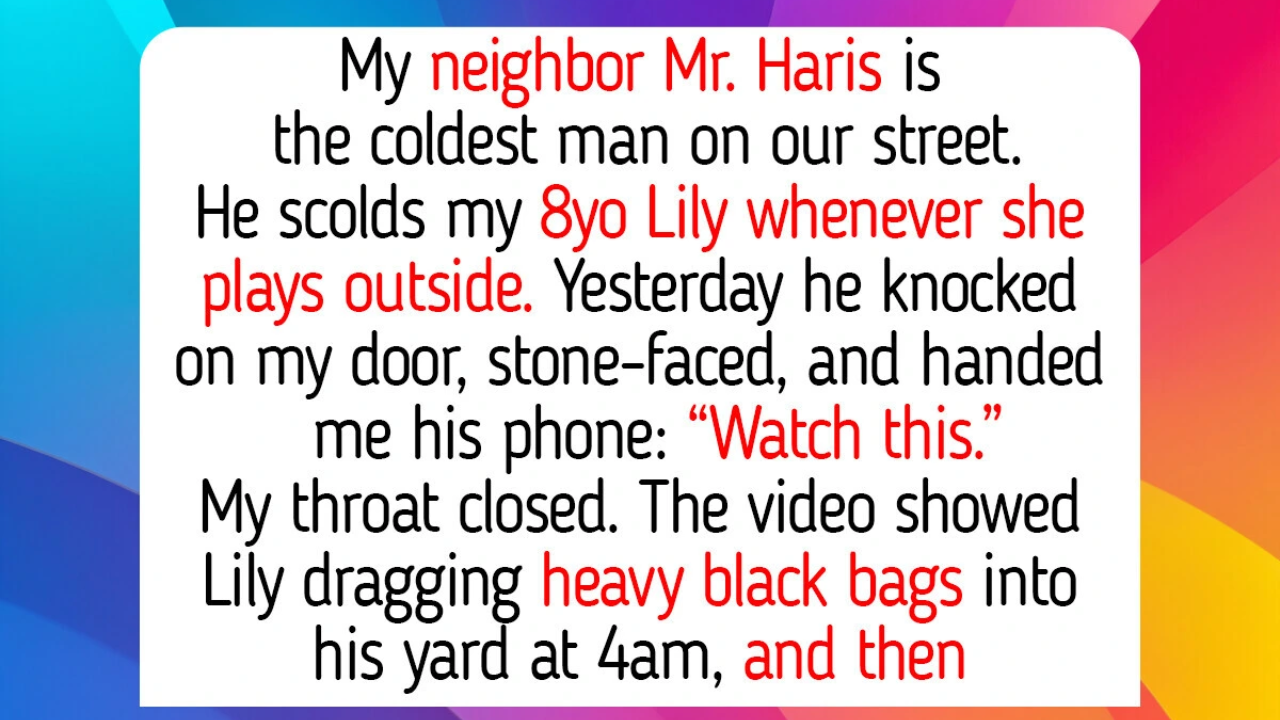
Mr. Haris was known as the least friendly man on our street. He frequently complained when my eight-year-old daughter, Lily, played outside, and his stern expressions made it clear that he preferred peace and quiet.
Then one morning, he knocked on our door holding his phone.
His face was serious as he handed it to me and said, “Watch this.”
The security footage showed Lily outside his house at four in the morning, dragging heavy bags across the yard. At first, I could not understand what I was seeing. She appeared to be carrying something away from the trees and placing it near the curb.
Mr. Haris asked me to keep watching.
The video revealed that Lily had been collecting fallen autumn leaves from his oak trees, filling yard-waste bags, and arranging them neatly for collection. She even left a bottle of water and a rolled newspaper on his porch before returning home.
Mr. Haris explained that his back had been hurting after spending time in the cold weather trying to clear the leaves. Frustrated by the pain, he had snapped at Lily and told her to stop making noise outside.
Instead of holding a grudge, she had watched him struggling from the kitchen window and decided to help while everyone else was asleep.
She had also left a small handwritten note with a drawing of the sun. It read, “Don’t worry, Mr. Haris. I got the fallen leaves today so your legs can rest.”
The man who had spent years scolding my daughter stood on our doorstep with tears in his eyes. He had brought her fresh blueberry pastries as a thank-you.
After that morning, everything changed. Mr. Haris began sitting outside in his lawn chair, waving whenever Lily played in the yard and keeping a friendly eye on the street.
Lily’s kindness had accomplished something that arguments and apologies might never have achieved. It helped a grumpy neighbor recognize the caring child behind the noise he disliked.
Sometimes, compassion reaches people most effectively when it arrives without judgment or resentment.
4. A Care Home Worker Kept an Elderly Resident Company at Midnight
My aunt works night shifts at a care home in Tucson. Among the residents was Arthur, a 91-year-old man who had not received a visitor for four months.
The long nights were particularly difficult for him. Most residents eventually settled down to rest, but Arthur often stayed awake watching the late news. Without family members or friends dropping by, the hours could feel painfully empty.
My aunt noticed how alone he seemed during her shifts. Rather than treating his loneliness as something beyond her responsibilities, she began spending her fifteen-minute break sitting beside him.
They watched television together, occasionally discussed the news, and shared the quiet comfort of another person’s presence.
She continued doing this for seven months. It was never presented as a special project, and she did not announce her efforts to the other staff members. She simply understood that Arthur disliked being alone at midnight.
When his daughter finally visited in the spring, she asked who the night nurse was. Arthur had mentioned my aunt during nearly every phone call, describing the person who regularly sat with him after dark.
My aunt had not realized how much those brief visits meant to him.
To her, it was only fifteen minutes. To Arthur, it was a dependable moment of companionship in a day that might otherwise have felt lonely.
Her story shows that caring for someone does not always require extra money, elaborate activities, or hours of free time. Sometimes, being present is the most valuable thing we can offer.
5. A Widow’s Extra Flowers Created an Unexpected Friendship
After losing her husband, a woman found comfort in spending time in her garden. Caring for the plants gave her something meaningful to do during days that otherwise felt long and quiet.
By summer, the garden had produced more flowers than she could reasonably keep. Rather than allowing the extra blooms to go unused, she began leaving small bouquets in her neighbors’ yards.
She did not attach notes or explain why she had left them. She simply hoped someone might enjoy a little color in their day.
One afternoon, a woman knocked on her door and asked whether she was the person leaving flowers around the neighborhood.
The widow confirmed that she was.
The visitor explained that she had been undergoing chemotherapy since March. Every Monday, she had discovered a fresh bouquet on her porch and assumed it came from a local church group.
The flowers had become a small source of comfort during a frightening and exhausting period of treatment.
The widow had known nothing about the woman’s illness. She had only been sharing what her garden produced in abundance.
After they spoke, the visitor asked whether she could sit in the garden for a while. That first visit turned into several more, and a quiet friendship began to develop.
Neither woman had planned to find companionship through the flowers. One was coping with grief, while the other was facing a serious illness. Yet their lives intersected because one person had chosen to share something beautiful.
The bouquets could not remove their difficulties, but they created an opening for conversation and mutual support.
Sometimes, a small gift becomes meaningful in ways we cannot predict. We may never know what someone is going through, but a thoughtful gesture can reach them at exactly the right time.
6. A Cousin Made a Handmade Arm for Someone Who Had Lost One
After losing an arm, one person struggled with the emotional adjustment as well as the practical changes that followed. Learning to live with a changed body was a deeply personal experience, and some days were harder than others.
Then their cousin Kevin decided to make something special.
He spent forty-eight hours crocheting a handmade arm. It was not a medical prosthesis and could not replace the function of a professionally fitted device. Instead, it offered a soft, tangible shape that the person could touch, hold, and personalize.
The gift provided comfort in an unexpected way. It had a distinctive character, and its handmade quality made it feel personal rather than clinical.
More importantly, wearing it helped the recipient feel more confident and comfortable with their appearance.
Kevin had not been able to undo what happened, but he had found a way to respond with care. He invested time and effort in creating something that acknowledged his cousin’s experience without reducing the person to their loss.
The gesture also demonstrated that support does not always need to take the form of advice. Sometimes, people need someone willing to listen, understand what might bring comfort, and make something thoughtful with their own hands.
The crocheted arm was not a medical solution. It was a reminder of affection, creativity, and the strength of a family connection.
For the recipient, that made it valuable in a way that went beyond its physical appearance.
7. A Granola Bar Helped Someone Through a Frightening Night at the Hospital
At one in the morning, I sat alone in the waiting room at St. Jude’s Hospital in Peoria, waiting for news about my father.
I had not eaten since noon, and anxiety had made it difficult to think about anything beyond the possibility that something might be wrong. The waiting room was quiet, and every passing minute seemed longer than the one before it.
A woman sitting two chairs away reached into her bag, took out two granola bars, and placed one on the empty chair between us.
She did not ask questions or offer a speech. She did not even look up to see whether I would accept it.
I picked up the granola bar and ate it.
The woman left about an hour later without saying a word. Eventually, I learned that my father was fine, but I never forgot the small gesture that had helped me get through the night.
I had been frightened, hungry, and completely alone. The woman could not change the medical situation, and she did not know my story. Still, she noticed an opportunity to help and acted without expecting gratitude.
Since then, I have carried a granola bar in my bag every day.
I keep it in case I encounter someone waiting alone at an odd hour, someone who has forgotten to eat while worrying about a loved one, or someone who simply needs a little help.
One stranger’s quiet kindness inspired me to prepare for the possibility of helping another person.
A small snack did not solve my problem, but it made a difficult night feel less lonely. Sometimes, that little bit of comfort is exactly what someone needs.
8. A Hairdresser Gave a Homeless Teenager a Fresh Start
A teenage girl once walked into a small hair salon and asked how much a haircut would cost. Her hair was badly tangled, and she had not washed it in weeks.
The hairdresser quoted the usual price of thirty-five dollars. The girl opened her hand and revealed seven dollars in coins.
She began to leave, embarrassed that she could not afford the service.
The hairdresser stopped her and invited her to sit down.
For the next two hours, the stylist carefully washed, conditioned, trimmed, and styled her hair. When the girl finally looked in the mirror, she began to cry.
“I look normal,” she said.
The hairdresser gently asked what had been happening. The girl explained that she was seventeen, homeless, and sleeping in her car while trying to finish high school. She had a job interview the following morning and wanted to look presentable.
The stylist returned her seven dollars and wished her luck.
The girl got the job and continued visiting the salon each month, always bringing seven dollars. The hairdresser accepted the money without telling her that the service cost much more.
Over time, the teenager graduated from high school and entered community college. Eventually, she became a social worker.
Two years after graduating, she returned to the salon with twelve girls from a homeless shelter. They all had upcoming job interviews and needed help feeling confident.
The hairdresser and her staff gave every girl a free makeover, haircut, and moment of encouragement. The original teenager stood beside them, emotional as she watched the kindness she had received being passed along.
The salon began organizing monthly “Fresh Start Fridays” to support other young people preparing for interviews.
One compassionate decision had grown into a continuing effort to help people find opportunities.
The hairdresser had done much more than style someone’s hair. She had treated a vulnerable teenager with dignity and helped her face an important day with confidence.
9. A Fifth-Grader Helped a New Student Find Friendship Without Sharing a Language
When my daughter came home from fifth grade, she told me about a new girl in her class. The girl came from an immigrant family, spoke limited English, and spent lunchtime sitting alone.
Nobody was deliberately unkind to her. The other children simply stayed with their existing friends, and communicating with someone who spoke another language seemed difficult.
My daughter decided to sit beside her.
They did not share enough language to hold a normal conversation, so my daughter used the translation app on her school iPad. They typed messages back and forth, laughed at some of the strange translations, and began teaching each other words.
They shared lunch and found ways to communicate even when the app failed to express what they meant.
Other students noticed their friendship and began joining them. Before long, the lunch table included children learning words from different languages and helping one another understand unfamiliar expressions.
Their teacher later called to explain how much the new girl’s confidence had improved. She was participating more, smiling more often, and becoming increasingly comfortable in class.
When I asked my daughter why she had made the effort, she looked confused.
“She was alone. Nobody should eat lunch alone,” she said.
To her, the decision seemed obvious. She had seen someone without company and made room.
Her response reminded me how easily adults can overcomplicate kindness. We worry about awkward conversations, differences, and whether we have enough in common. Children sometimes recognize a simpler truth: another person is alone, and we can choose to sit beside them.
My daughter did not need to speak the same language to begin a friendship. She only needed to be willing to try.
10. A Beachgoer’s Small Favor Led to an Unforgettable Dolphin Encounter
One day off, I was struggling with my thoughts and decided to walk along a beach I had never visited before.
I eventually lay down to enjoy the sunshine with my headphones in. Then I heard someone calling and opened my eyes to see an older man standing nearby with his bicycle.
He asked whether I could watch his backpack while he swam out toward the buoys. I was tempted to refuse because I wanted to be left alone, but he seemed friendly, and the request was simple.
I agreed, explaining that I had only been walking and might not stay long. He said he would probably be gone for twenty minutes.
Looking around, he admitted that there were not many people nearby to ask. I laughed and promised to stay a little longer.
I had gone to the beach to escape my thoughts, but keeping an eye on his bag encouraged me to slow down and enjoy the day.
When the man returned, he was bursting with excitement. During his swim, he had heard dolphins singing underwater. Someone on the beach had recorded a video showing the dolphins swimming nearby, and he could hardly believe what had happened.
He thanked me repeatedly, saying that my willingness to watch his backpack had allowed him to enjoy this remarkable experience without worrying about his belongings.
I was amazed that he was thanking me for such a small favor. His happiness was infectious, and the encounter transformed my own day as well.
We had met by chance, shared a brief moment of trust, and parted with a memory neither of us had expected.
The experience reminded me that kindness can benefit both people involved. Sometimes, helping someone else enjoy a moment of happiness allows us to experience a little joy ourselves.
Conclusion
These ten stories show that meaningful human connection often begins with something ordinary. A shared sandwich, a birthday card, a child’s thoughtful note, or a few minutes of company can make a person feel noticed and valued.
Kindness does not require us to solve every problem someone faces. We may not be able to remove another person’s grief, financial hardship, illness, or loneliness. But we can listen, offer practical help, share what we have, and treat people with dignity.
The most powerful gestures are not always the ones that attract attention. Often, they happen quietly, without photographs or public recognition, because someone simply decides that another person’s well-being matters.
We may never fully understand how much a small act means to someone who is struggling. That is why it is worth choosing compassion whenever we can.
A few minutes of our time might become the reason someone feels less alone. A simple invitation might help a stranger find a community. And a small favor might inspire a chain of kindness that continues long after the original moment has passed.
Sometimes, changing someone’s day begins with nothing more than noticing them and choosing to care.

Jante Smith is a creative and dedicated content writer who loves turning ideas into clear and engaging stories. She writes blog posts and articles that connect with readers. She ensures every piece of content is well-structured and easy to understand. Her writing helps our brand share useful information and build strong relationships with our audience.