
Rugby Scrum Rules Explained
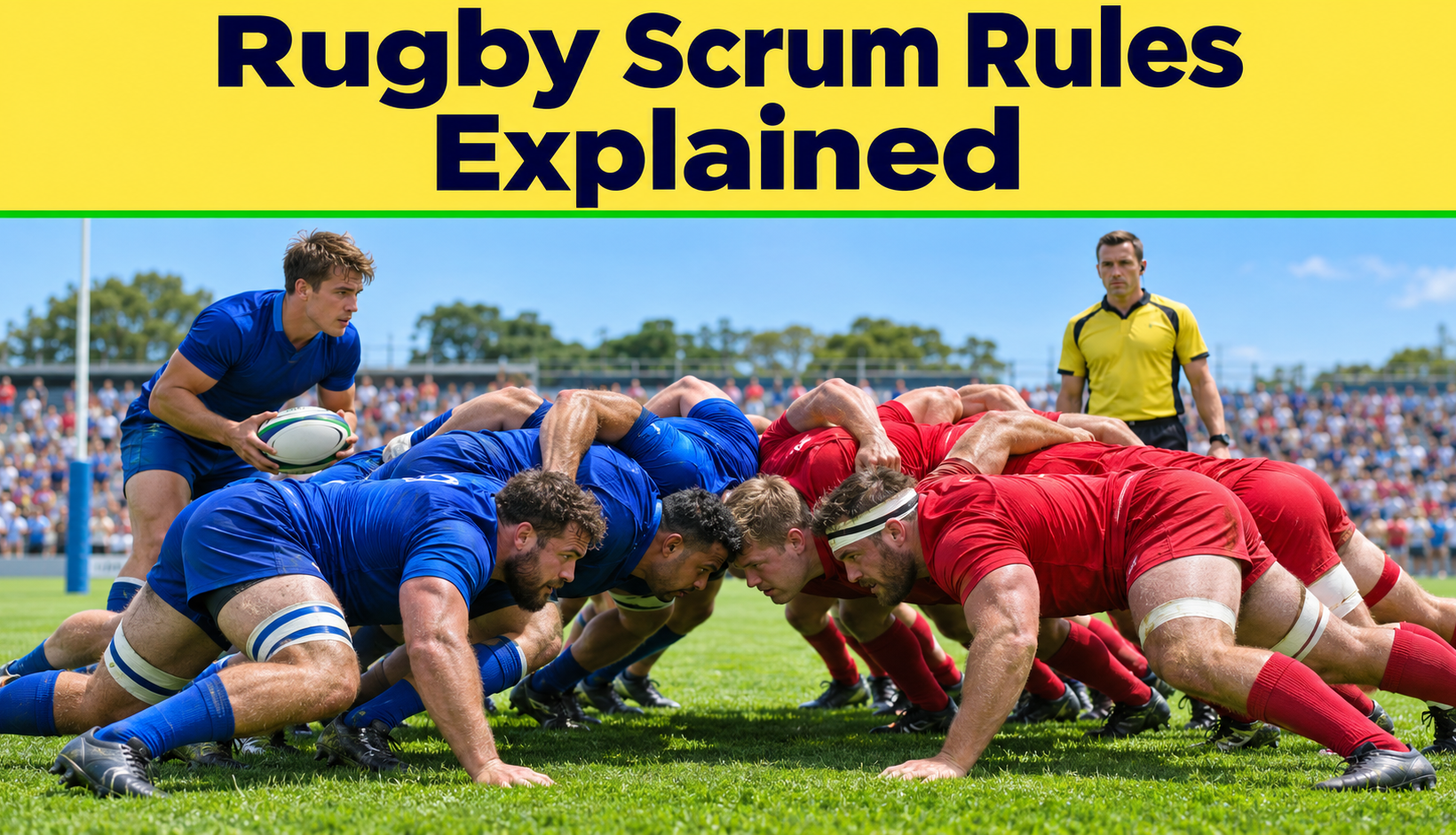
The scrum is one of the most recognisable and misunderstood parts of rugby. Sixteen players bind together, push against each other and compete for the ball, all under a detailed set of laws designed to keep the contest fair and safe.
In rugby union, the scrum is used to restart play after minor infringements such as a knock-on or forward pass, and it is also a powerful attacking platform. The laws are set by World Rugby and cover how the scrum forms, how players bind and engage, how the ball is put in, where other players must stand and what counts as an offense. This guide explains rugby union scrum rules step by step, the role of each position, common penalties, safety rules and how scrums differ in rugby league.
When a Scrum Is Awarded
A scrum restarts play quickly and safely after a minor infringement or stoppage. The most common reasons include:
- A knock-on, when the ball is lost forward from a player’s hands.
- A forward pass.
- The ball becoming unplayable in a ruck or maul.
- Accidental offside.
- The ball not being made available at a tackle in certain situations.
- A team choosing a scrum instead of taking a penalty or free kick.
The non-offending team usually gets the put-in. The scrum takes place at the mark where the infringement happened, but no closer than five metres from the touchline or goal line.
Scrum Positions and Roles
A full rugby union scrum has eight players from each team, arranged in three rows.
| Position | Shirt Number | Main Scrum Role |
|---|---|---|
| Loosehead prop | 1 | Supports the hooker and attacks the opposing tighthead |
| Hooker | 2 | Strikes the ball back with the foot |
| Tighthead prop | 3 | Anchors the scrum against two opponents |
| Locks | 4 and 5 | Provide the main pushing power |
| Flankers | 6 and 7 | Bind on the sides and break quickly |
| Number 8 | 8 | Controls the ball at the base |
The scrum-half, usually wearing number 9, is not part of the scrum but feeds the ball in and collects it when it comes out. Props and hookers are specialist positions because the front row carries the most physical load and safety risk.
Forming the Scrum
Before engagement, each team forms its scrum in a set shape. The front row binds together, with the hooker in the middle. The two locks bind onto each other and push through the front row, the flankers bind onto the sides, and the number 8 binds between the locks at the back.
The two front rows set up facing each other about an arm’s length apart, with heads and shoulders no lower than the hips. The middle line between the two front rows, called the tunnel, is where the ball will be put in.
Engagement: Crouch, Bind, Set
The referee controls the engagement with three calls designed to make scrums safer and more stable:
- Crouch: the front rows crouch with heads and shoulders above hip level.
- Bind: the props bind on their opponents, with the loosehead binding on the back or side of the opposing tighthead’s jersey and the tighthead binding on the loosehead.
- Set: the two packs come together and the scrum is formed.
Engaging before the referee’s call, often called early engagement, is a free kick offense. The pre-bind approach was introduced to reduce the impact of the hit and the number of collapsed scrums.
Feeding the Ball
Once the scrum is set and stable, the scrum-half of the team awarded the scrum puts the ball in. The rules require:
- The scrum-half stands one metre from the scrum on the middle line.
- The ball is held with both hands and thrown in without delay.
- The ball must be put in straight along the middle line, though referees allow a small tolerance in practice.
- The ball must touch the ground inside the tunnel beyond the width of the nearest prop’s shoulders.
A crooked feed is a free kick offense. Once the ball is put in, any front row player may try to win it, though in practice the hooker of the team feeding the ball usually strikes it back.
During the Scrum
After the feed, both packs push to win the ball or disrupt the opponents. The ball moves back through the players’ feet until it reaches the base of the scrum. Players must not handle the ball while it is in the scrum, and they must stay bound until the scrum ends.
Options at the Base
- The scrum-half picks up the ball and passes or runs.
- The number 8 picks up the ball and runs, or passes to the scrum-half.
- The team drives forward with the ball at the number 8’s feet, gaining ground.
When the Scrum Ends
The scrum ends when the ball leaves the scrum, when the number 8 unbinds and picks it up, when the ball reaches or passes the goal line, or when the scrum collapses or wheels so far that the referee resets it.
Offside Lines at the Scrum
Offside rules prevent players from interfering before the ball is out:
- Scrum-halves: the feeding scrum-half stays near the ball, and the opposing scrum-half may follow the ball or retire behind the scrum, but cannot move into certain areas around the scrum.
- Other backs: players not in the scrum must stay at least five metres behind the hindmost foot of their team’s scrum until it ends.
- Flankers: must stay bound until the ball is out and cannot detach to tackle early.
Breaking offside lines at the scrum is a penalty offense.
Common Scrum Penalties and Free Kicks
The scrum is a frequent source of penalties, which can lead to kicks at goal, territory gains or another scrum. Common offenses include:
- Collapsing: deliberately bringing the scrum down, which is dangerous and penalised.
- Standing up: a front row player popping out of the scrum to relieve pressure.
- Boring in: a prop pushing at an angle into the hooker or across the scrum instead of straight.
- Illegal binding: binding on the arm instead of the body or pulling down an opponent.
- Not pushing straight: deliberately wheeling the scrum.
- Handling in the scrum: using hands to play the ball inside the scrum.
- Early engagement and crooked feeds: both normally result in free kicks rather than full penalties.
Referees judge which team caused a problem, which is why scrum decisions often spark debate among fans and pundits.
Resets and Wheeling
If a scrum collapses accidentally or becomes unstable, the referee may reset it. A scrum that wheels too far from its original direction is also stopped and restarted. Repeated resets slow the game, so referees try to identify which team is at fault and award a penalty or free kick where possible.
Uncontested Scrums
Because front row play is so specialised and risky, scrums become uncontested when a team cannot field enough trained front row players, often due to injury or a sending-off. In an uncontested scrum, teams form up but do not push, and the team feeding the ball must win it. Competition rules often include measures to prevent teams from using uncontested scrums for tactical advantage.
Safety and Youth Rugby
Scrums carry a risk of neck and spinal injuries, particularly when they collapse. For this reason, World Rugby and national unions have strict safety rules, specialist front row coaching and player welfare programmes. Youth and community rugby often use modified scrum rules, such as limits on how far a team may push and restrictions on wheeling.
Players, parents and clubs should ensure proper coaching, conditioning of neck and core muscles and appropriate sports injury insurance. Physiotherapy and strength programmes help front row players prepare for the demands of the position.
Scrums in Rugby League
Rugby league uses a very different scrum. Each team has six players in the scrum, the contest is largely uncontested, and the team awarded the feed almost always wins the ball. The league scrum mainly serves to bring forwards together and create space for backs. In recent years, some rugby league competitions have reduced or replaced scrums in certain situations.
Tips for Watching and Understanding Scrums
- Watch the tighthead prop, whose stability often decides the contest.
- Look at body height: the team that stays low and square usually wins.
- Notice which prop the referee is watching before a penalty is given.
- See whether the attacking team keeps the ball at the base to drive forward.
Final Thoughts
The rugby union scrum is a structured contest of strength, technique and timing. Eight players per side bind together, engage on the referee’s crouch, bind and set calls, and compete for a ball fed straight down the middle. Strict laws on binding, pushing, offside lines and collapsing keep the scrum fair and safe, while penalties won at the scrum can decide matches.
FAQs
1. How many players are in a rugby scrum?
In rugby union, each team has eight players in the scrum. In rugby league, there are six.
2. What does crouch, bind, set mean in rugby?
They are the referee’s three calls that control how the front rows prepare, bind and engage safely.
3. Why are scrums reset so often?
Scrums are reset when they collapse, wheel too far or become unstable, often due to infringements by one team.

Jante Smith is a creative and dedicated content writer who loves turning ideas into clear and engaging stories. She writes blog posts and articles that connect with readers. She ensures every piece of content is well-structured and easy to understand. Her writing helps our brand share useful information and build strong relationships with our audience.