
History of the Wallabies
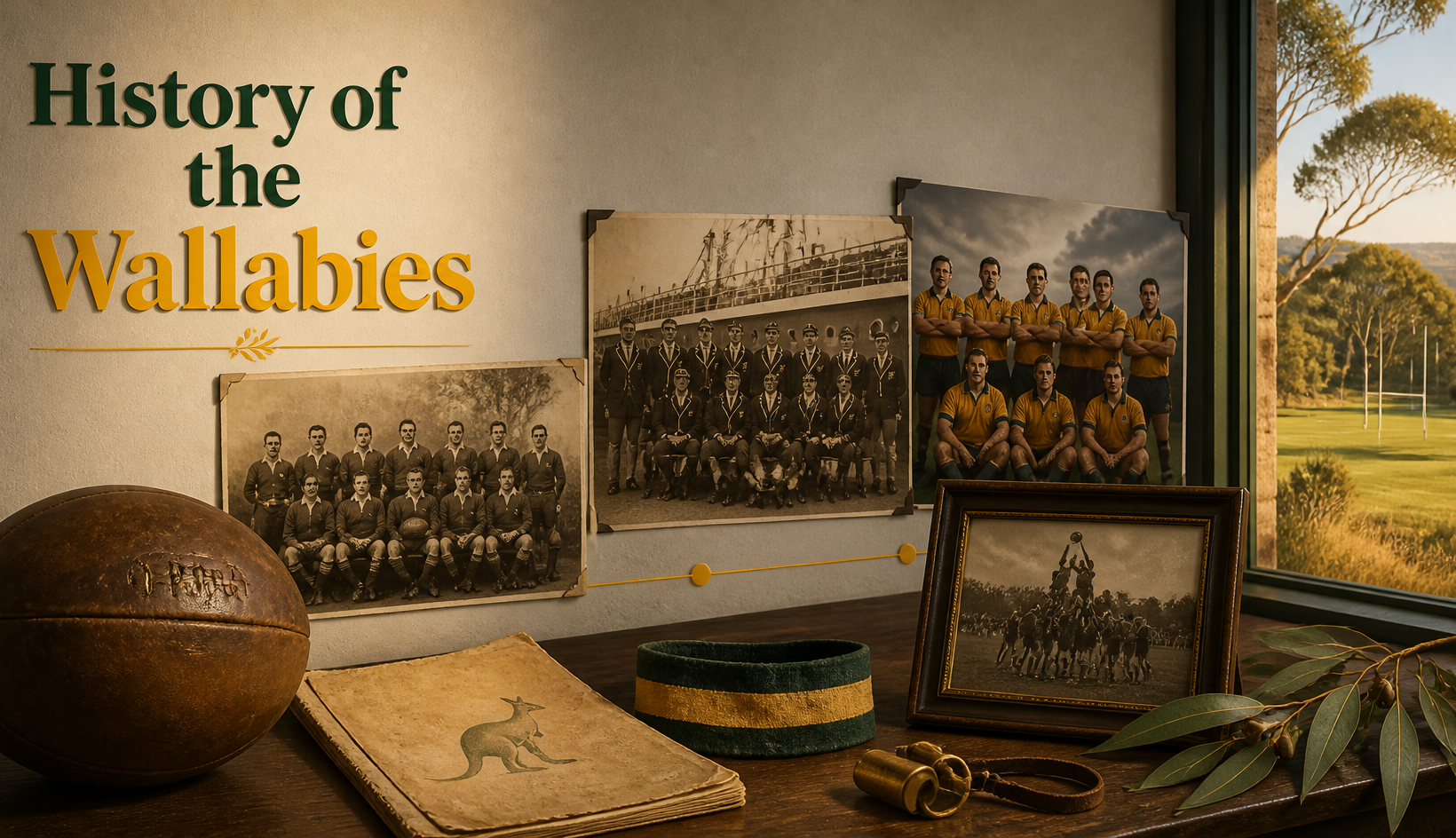
The Wallabies, Australia’s national rugby union team, have one of the richest histories in world sport. From their first Test in 1899 to two Rugby World Cup titles and a new era under Les Kiss, the gold jersey has produced legendary players, unforgettable matches, and fierce rivalries with New Zealand, England, South Africa, and the British and Irish Lions.
This article traces the history of the Wallabies, from their earliest years to the present day, highlighting the key eras, famous players, and defining moments.
Early Years: 1899 to 1945
Australia played its first rugby Test in 1899 against a touring British Isles team in Sydney, winning that first match. In those early days, rugby was strongest in New South Wales and Queensland.
How the Wallabies Got Their Name
The name “Wallabies” comes from the 1908 to 1909 tour of Britain. British newspapers wanted a nickname for the touring Australians, and the team became known as the Wallabies. The same squad also won the rugby gold medal at the 1908 London Olympics, one of the earliest highlights in Australian sporting history.
Struggles After the Split
Soon after, many leading players switched to rugby league, which was professional and growing fast. Rugby union in Australia went through a difficult period, and during the First World War, many players served in the armed forces. In the 1920s, the New South Wales Waratahs carried the international game, with their matches later recognised as Tests.
The Bledisloe Cup Begins
The Bledisloe Cup, donated by Lord Bledisloe, was first contested in the early 1930s and has since become one of rugby’s most famous trophies. New Zealand have dominated the competition overall, but the rivalry has produced countless classic matches.
Rebuilding: 1946 to 1970s
After the Second World War, Australia rebuilt its national team, touring regularly and hosting visiting sides. Results were mixed, but the period produced respected players and a growing competition structure. During the 1970s, players from Victoria and other non-traditional states occasionally broke into the team, including Melbourne Kiwis club players John Meadows and Doug Osborne.
The Rise of a Power: The 1980s
The 1980s transformed Australian rugby. Under coach Alan Jones, the 1984 Wallabies completed a historic Grand Slam tour, beating England, Ireland, Wales, and Scotland. Flyhalf Mark Ella scored a try in all four Tests, and the team played an attacking style that impressed the rugby world.
The decade also saw the first Rugby World Cup in 1987, co-hosted by Australia and New Zealand. The Wallabies reached the semi-finals, losing a thriller to France.
Legendary Players of the Era
- Mark Ella: a brilliant playmaker
- David Campese: one of the most exciting wingers in rugby history
- Nick Farr-Jones: scrumhalf and future World Cup-winning captain
- Michael Lynagh: a reliable goal-kicker and tactician
World Champions: The 1990s
1991 Rugby World Cup
Coached by Bob Dwyer and captained by Nick Farr-Jones, the Wallabies won their first World Cup in 1991. They beat New Zealand in a famous semi-final in Dublin and defeated England in the final at Twickenham.
The Professional Era
Rugby union became professional in 1995. Australia joined New Zealand and South Africa in the new Super 12 club competition and the Tri Nations Test series, creating a more demanding international calendar.
1999 Rugby World Cup
Under coach Rod Macqueen and captain John Eales, the Wallabies won their second World Cup in 1999, beating France in the final in Cardiff. The team was built on a famously strong defence, and Australia became the first nation to win the tournament twice.
A Golden Period and a Home World Cup: 2000 to 2003
The early 2000s were among the most successful in Wallabies history:
- Tri Nations titles in 2000 and 2001
- A series win over the British and Irish Lions in 2001
- Holding the Bledisloe Cup until 2002
Australia hosted the 2003 Rugby World Cup. Coached by Eddie Jones, the Wallabies beat New Zealand in the semi-finals but lost the final to England in extra time in Sydney, decided by Jonny Wilkinson’s drop goal.
Key players of this era included George Gregan, Stephen Larkham, John Eales, and George Smith.
Ups and Downs: 2004 to 2019
| Year | Highlight |
|---|---|
| 2011 | Won the Tri Nations and reached the World Cup semi-finals |
| 2015 | Won the Rugby Championship and reached the World Cup final under Michael Cheika |
| 2019 | Reached the World Cup quarter-finals |
The 2015 World Cup run was a highlight, with Australia beating England and Wales in the pool stage and Scotland in a dramatic quarter-final before losing the final to New Zealand.
Recent Years: 2020 to Today
The 2020s have been challenging. The Wallabies were knocked out in the pool stage of the 2023 Rugby World Cup for the first time, including a heavy loss to Wales. Joe Schmidt then took charge, and in 2025 Australia hosted the British and Irish Lions, with record crowds including more than 90,000 at the MCG.
In mid-2026, Les Kiss became head coach. His early highlights included a series win in Argentina and a dramatic 42 to 38 victory over world champions South Africa in Perth, though heavy Bledisloe Cup defeats to New Zealand showed the work still ahead.
Unforgettable Moments
- 1984: Mark Ella’s try in every Test of the Grand Slam tour
- 1991: David Campese’s brilliance in the World Cup semi-final against New Zealand
- 1994: George Gregan’s famous try-saving tackle on Jeff Wilson to secure a Bledisloe Cup win
- 2000: John Eales kicking a late penalty to beat the All Blacks in Wellington
- 2015: a dramatic one-point World Cup quarter-final win over Scotland
Moments like these are part of Australian sporting folklore and are still replayed by fans today.
Major Achievements
| Achievement | Details |
|---|---|
| Rugby World Cup titles | 1991 and 1999 |
| World Cup finals | 1991, 1999, 2003, 2015 |
| Olympic gold | 1908 London |
| Grand Slam tour | 1984 |
| Tri Nations and Rugby Championship titles | 2000, 2001, 2011, 2015 |
Great Rivalries
- New Zealand: the Bledisloe Cup rivalry, one of the oldest and most intense in sport
- England: including World Cup finals in 1991 and 2003
- South Africa: physical battles in the Rugby Championship
- British and Irish Lions: tours every 12 years in Australia
Looking Ahead
The next chapter is the 2027 Rugby World Cup in Australia, where the Wallabies will open the tournament against Hong Kong China in Perth and face New Zealand in Sydney. A home World Cup offers a huge chance to inspire a new generation, just as the 1991 and 1999 triumphs did.
Final Thoughts
The history of the Wallabies is a story of resilience, flair, and big moments: from the first Test in 1899 and Olympic gold in 1908, to the 1984 Grand Slam, World Cup titles in 1991 and 1999, and the rebuilding of recent years. With a home World Cup ahead, the gold jersey’s next great era may be just around the corner.

Jante Smith is a creative and dedicated content writer who loves turning ideas into clear and engaging stories. She writes blog posts and articles that connect with readers. She ensures every piece of content is well-structured and easy to understand. Her writing helps our brand share useful information and build strong relationships with our audience.