
How the TMO Works in Rugby
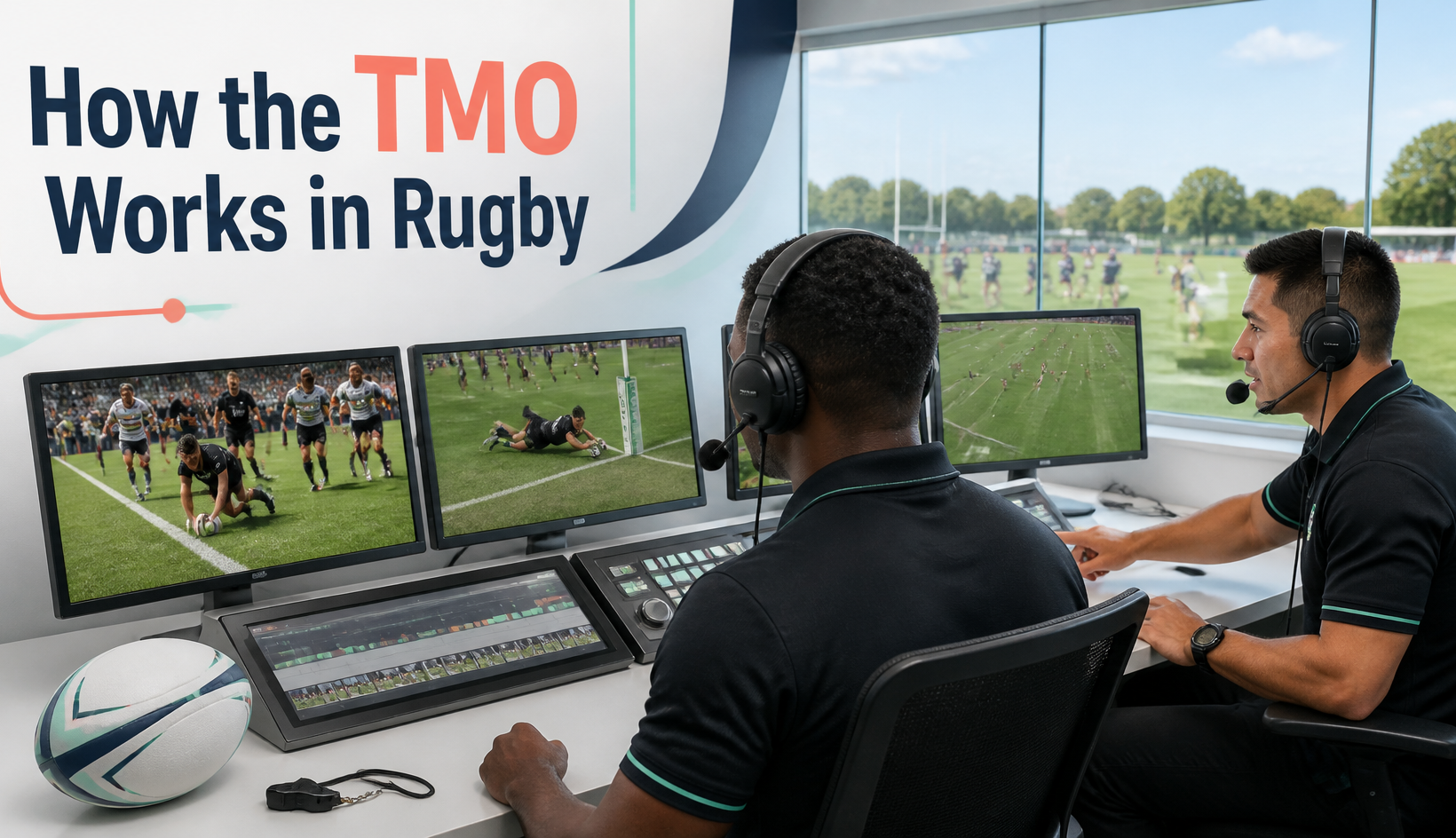
If you have watched a professional rugby match, you have probably seen the referee draw a rectangle in the air and the crowd fall silent while replays appear on the big screen. That moment involves the Television Match Official, or TMO, one of the most important and most debated roles in modern rugby.
This guide explains how the TMO works in rugby union, what decisions can be reviewed, how the process unfolds during a match, the newer “bunker” system for foul play, and why the TMO is both praised and criticised.
What Is the TMO?
The TMO is a match official who sits away from the field and watches the game on multiple camera feeds. Their job is to help the on-field referee make correct decisions on key incidents using video replays. The TMO communicates with the referee through a radio link, and in many competitions their conversations can be heard by television viewers.
The TMO is used in professional and elite rugby, such as Test matches, Super Rugby Pacific, the Nations Championship, and the Rugby World Cup. Community rugby does not usually have video review.
A Brief History
Video review has been part of top-level rugby since the early 2000s. At first, it was used mainly to check whether tries had been scored. Over time, its role expanded to include foul play and infringements in the lead-up to tries, as broadcast technology improved and player safety became a bigger priority. Today, top matches use many camera angles, giving the TMO far more evidence than early reviewers had.
The TMO at the 2027 World Cup
With the 2027 Men’s Rugby World Cup coming to Australia, fans can expect the TMO and foul play review system to play a major role. Every match will feature professional broadcast coverage and video review, and big decisions in knockout matches are likely to be debated long after the final whistle.
The Match Officials Team
| Official | Role |
|---|---|
| Referee | Makes final decisions on the field |
| Assistant referees | Monitor the touchlines, goal kicks, and foul play |
| TMO | Reviews video evidence for tries and foul play |
| Foul play review official | In some competitions, reviews yellow cards to decide if they should be upgraded |
Even with video support, the referee remains in charge. The TMO advises, but the referee makes the final call.
What the TMO Can Review
1. Try-Scoring Decisions
The most common use of the TMO is checking whether a try has been scored. Questions might include:
- Did the player ground the ball with downward pressure?
- Was the player in touch or in touch-in-goal before grounding?
- Was the ball knocked on during the grounding?
- Was a defender preventing the grounding?
2. Infringements in the Lead-Up to a Try
The TMO can also check for clear infringements in the build-up to a try, such as a forward pass, knock-on, or obstruction. World Rugby protocols set limits on how far back the TMO can look, to avoid re-examining long passages of play.
3. Foul Play
The TMO can review incidents of possible foul play, such as high tackles, dangerous clean-outs, tip tackles, and punching. They help the referee decide whether a penalty, yellow card, or red card is appropriate. Foul play can be reviewed even if the referee did not see it at the time.
4. Goal Kicks
In some competitions, the TMO can help confirm whether a kick at goal passed between the posts, particularly when the ball goes above the uprights.
How a TMO Review Works
- The trigger: the referee asks for a review, or the TMO alerts the referee to something they may have missed
- The signal: the referee forms a rectangle shape with their hands to show a review is under way
- The question: the referee often frames a specific question, such as “Is there any reason I cannot award the try?”
- The replays: the TMO examines different camera angles, sometimes in slow motion
- The discussion: the TMO and referee talk through what the footage shows
- The decision: the referee gives the final decision on the field
On-Field Decisions
In many situations, the referee gives an initial view, sometimes called an on-field decision, before going to the TMO. The TMO then looks for clear evidence to confirm or change that decision. If the evidence is inconclusive, the original decision usually stands.
The Foul Play “Bunker”
In recent years, World Rugby has introduced a foul play review system, often called the “bunker.” Under this system:
- When a possible red card offence happens, the referee can show a yellow card
- The player leaves the field while a separate review official examines the incident in more detail
- If the review finds the offence meets the red card threshold, the yellow is upgraded to a red
This approach lets play continue quickly instead of stopping for long on-field reviews, while still allowing serious incidents to be checked thoroughly.
The 20-Minute Red Card
In some elite competitions and international rugby, a 20-minute red card is used for certain offences. The player is sent off permanently, but a replacement can come on after 20 minutes. More deliberate or dangerous acts can still lead to a full red card, where the team plays with 14 players for the rest of the match.
In a 2026 Test in Osaka, for example, Wallabies lock Miles Amatosero was given a yellow card for a shoulder to the head that was then upgraded to a 20-minute red, showing how these systems now work together.
Benefits of the TMO
- Accuracy: helps get big decisions right, especially tries
- Player safety: ensures dangerous play is identified and punished
- Fairness: reduces the impact of honest mistakes on results
- Transparency: fans can often hear the reasoning behind decisions
Criticisms of the TMO
Despite its benefits, the TMO is often criticised:
- Delays: long reviews can slow the game and frustrate spectators
- Re-refereeing: some feel the TMO intervenes too often in minor incidents
- Inconsistency: similar incidents can sometimes lead to different decisions
- Technology issues: faults with screens or communications can cause confusion
Technology problems were highlighted in the 2026 Wallabies versus Springboks Test in Perth, where reported technical issues with match systems drew criticism during a dramatic finish.
How World Rugby Has Responded
World Rugby regularly updates TMO protocols to balance accuracy with the flow of the game. Common aims include:
- Limiting how far back reviews can go before a try
- Encouraging referees to make clear on-field decisions
- Using the bunker to speed up serious foul play reviews
- Setting time targets so reviews do not drag on
Tips for Fans Watching a TMO Review
- Listen to the referee’s question, which tells you what is being checked
- Watch the replays on the big screen or broadcast
- Remember that the original decision usually stands without clear evidence
- Be patient; important decisions can take a little time
Final Thoughts
How the TMO works in rugby comes down to a simple idea: using video replays to help the referee make the right call on tries and foul play. Supported by systems like the foul play bunker and the 20-minute red card, the TMO has become a central part of elite rugby. While debates about delays and consistency will continue, its main goal remains fairness and player safety.

Jante Smith is a creative and dedicated content writer who loves turning ideas into clear and engaging stories. She writes blog posts and articles that connect with readers. She ensures every piece of content is well-structured and easy to understand. Her writing helps our brand share useful information and build strong relationships with our audience.