
Women’s Rugby Growth in Victoria
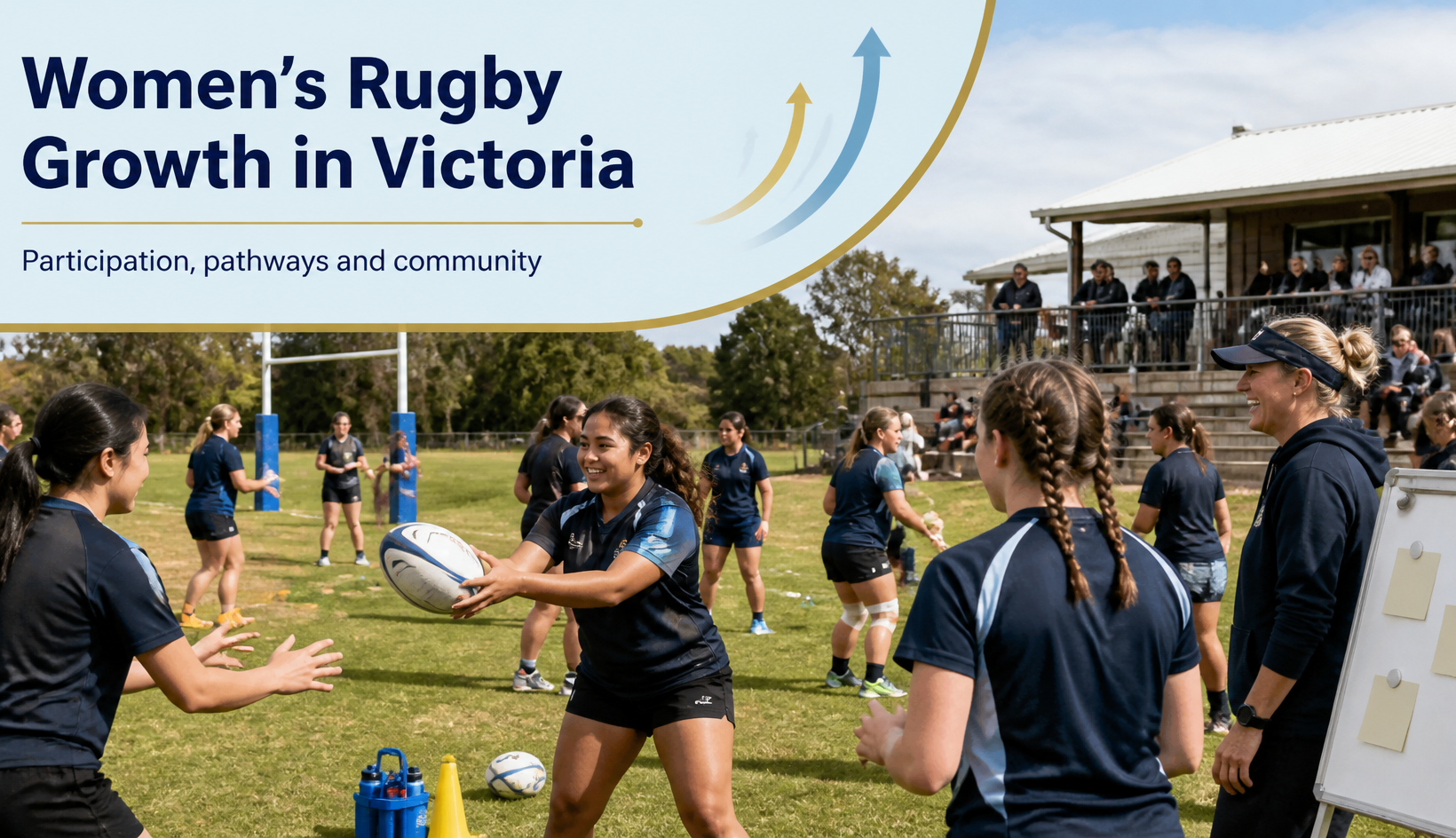
Thirty years ago, Victoria did not have enough female rugby players to run a competition. Today, the state has a premier women’s club competition, a new development tier, girls-only junior competitions, and an elite academy for its most talented young players. The rise of women’s rugby is one of the most positive stories in Victorian sport.
This article looks at how women’s rugby began in Victoria, the competitions and pathways that exist today, the challenges it has faced, and why the next few years could be the most important yet.
Humble Beginnings in the 1990s
Interest in women’s rugby in Victoria was first expressed in 1995. There were not enough players to form a club competition, so organisers did the next best thing: they formed a state team to compete at the 1996 Australian Women’s Championships in Sydney.
Most of that first squad were complete beginners. Led by captain Anne Nicholson, Victoria played three matches, losing two and winning one against Western Australia. It was a modest start, but it planted the seed for everything that followed. Two players from those early years, Holly Gifford and Melissa Latu, went on to represent Australia.
The Lindroth Legacy
The driving force behind that first team was Jenni Lindroth, who helped bring the squad together. Her husband, Graham Lindroth, a long-serving Moorabbin player with more than 500 games, became the team’s first coach, while his father, Rod, served as team manager.
Tragically, Graham and Jenni died in a bushfire in January 1997 while the team was preparing for that year’s national championships. In their honour, Victoria’s premier women’s competition was named the Lindroth Cup. Their name remains at the centre of women’s rugby in the state.
Women’s Rugby in Victoria Today
The game has come a long way since 1996. Rugby Victoria says participation is still expanding, with more competitions for players of different ages, abilities, and experience levels.
| Competition or Program | Level | Purpose |
|---|---|---|
| Lindroth Cup | Senior women | Victoria’s top women’s club competition |
| Lindroth Development Competition | Senior women | Second tier for developing players and emerging clubs |
| Girls-only junior competitions | Under 14, Under 16, Under 18 | Age-appropriate rugby for girls, introduced in 2026 |
| VJRC for girls | Under 16 and Under 18 | Talent identification and development |
| Women’s and Girls’ Elite Academy | Top identified players | Year-round high-performance training |
The Lindroth Cup
The Lindroth Cup is the pinnacle of women’s club rugby in Victoria. Recent finals have featured some of the state’s strongest clubs. In 2025, Power House and Endeavour Hills met in the Lindroth Cup grand final, and in 2026 Power House won the women’s title, alongside its men’s Dewar Shield premiership.
A New Development Tier
One of the most important recent additions is the Lindroth Development Competition. It gives newer players, emerging clubs, and teams working toward Lindroth Cup level a place to play competitive rugby without being overwhelmed. A second tier like this is a strong sign of growth, as it means there are now enough players to support more than one level.
Growing the Game From Junior Level
Strong senior competitions depend on a steady flow of young players, and this is where some of the biggest changes have happened.
Girls-Only Junior Competitions
In 2026, Victoria introduced girls-only competitions at Under 14, Under 16, and Under 18. This gives girls a dedicated space to learn and play with others of the same age, which can make the sport more welcoming and help keep players involved through their teenage years.
The Youth Girls State Cup
Victoria has also hosted dedicated girls’ tournaments. The inaugural Youth Girls State Cup in 2023 brought together teams from Victoria, South Australia, and Brisbane over two days at Harlequin Rugby Club. Victoria won the Under 16 and Under 18 finals and narrowly lost the Under 14 decider.
At the time, organisers noted that only two years earlier, following the COVID-19 disruptions, there had been no fifteen-a-side rugby for girls in Victoria at all. The tournament showed how quickly the game was recovering and growing.
High-Performance Pathways
In 2026, Rugby Victoria expanded its women’s and girls’ pathway with two main programs:
- The VJRC for girls: a six-week program from March that serves as the main entry point and talent identification step, open to current players, athletes from other sports, and newcomers
- The Women’s and Girls’ Elite Academy: a new year-round program launched in late April 2026, offering advanced coaching, strength and conditioning, and individual development plans
The girls’ program uses multi-year age windows, giving players more than one chance to develop and be selected. Victorian girls’ teams compete nationally, including at the Australian Schools and Junior Rugby Union Championships and the National Girls XV Invitational.
Challenges Along the Way
Growth has not always been smooth. Women’s rugby in Victoria has faced several setbacks:
- COVID-19: the pandemic disrupted competitions and left a gap in girls’ fifteen-a-side rugby
- The loss of the Rebels: the Melbourne Rebels women’s team played in Super W from 2018 to 2024, but Rugby Australia confirmed in late 2024 that it would not continue in 2025
- Facilities: many older pavilions were built mainly for men’s teams
- Coaching depth: more qualified coaches are needed as player numbers rise
The Rebels women won only a handful of matches in Super W, but the team gave Victorian players a professional-level stage. Without it, the club and state pathway now carries even more responsibility.
Better Facilities and Club Support
Local councils and clubs are working to close the facilities gap. New and renewed pavilions, such as the Lewin Reserve pavilion in Glen Iris completed in 2023, have been designed with change rooms suitable for all players after councils recognised that older buildings did not cater well for women and girls.
Rugby Victoria has also named women’s rugby a core strategic growth pillar. It wants premier clubs to strengthen their women’s programs, with a focus on participation, coaching depth, and pathway alignment. It has also sought expressions of interest from coaches to support Victorian women’s and girls’ teams.
The 2029 Opportunity
Australia will host the Women’s Rugby World Cup in 2029. For young Victorian players, this creates a clear goal. Girls who are in junior programs today could be the right age to push for national selection by the end of the decade. A home World Cup is also likely to bring new attention, sponsors, and players into the women’s game.
How to Get Involved
- Players: contact a local club, whether you are a beginner or an experienced athlete from another sport
- Parents: look for girls-only junior competitions and the VJRC expressions of interest early in the year
- Coaches: watch for Rugby Victoria calls for women’s and girls’ coaches
- Supporters: attend Lindroth Cup matches and share results online
Final Thoughts
Women’s rugby growth in Victoria has been remarkable, from a team of beginners in 1996 to a two-tier senior competition, girls-only junior rugby, and an elite academy in 2026. Built on the legacy of pioneers like Jenni and Graham Lindroth, and with a home World Cup on the horizon, the women’s game is set for an exciting future in the state.

Jante Smith is a creative and dedicated content writer who loves turning ideas into clear and engaging stories. She writes blog posts and articles that connect with readers. She ensures every piece of content is well-structured and easy to understand. Her writing helps our brand share useful information and build strong relationships with our audience.