
Rugby Union vs Rugby League Differences
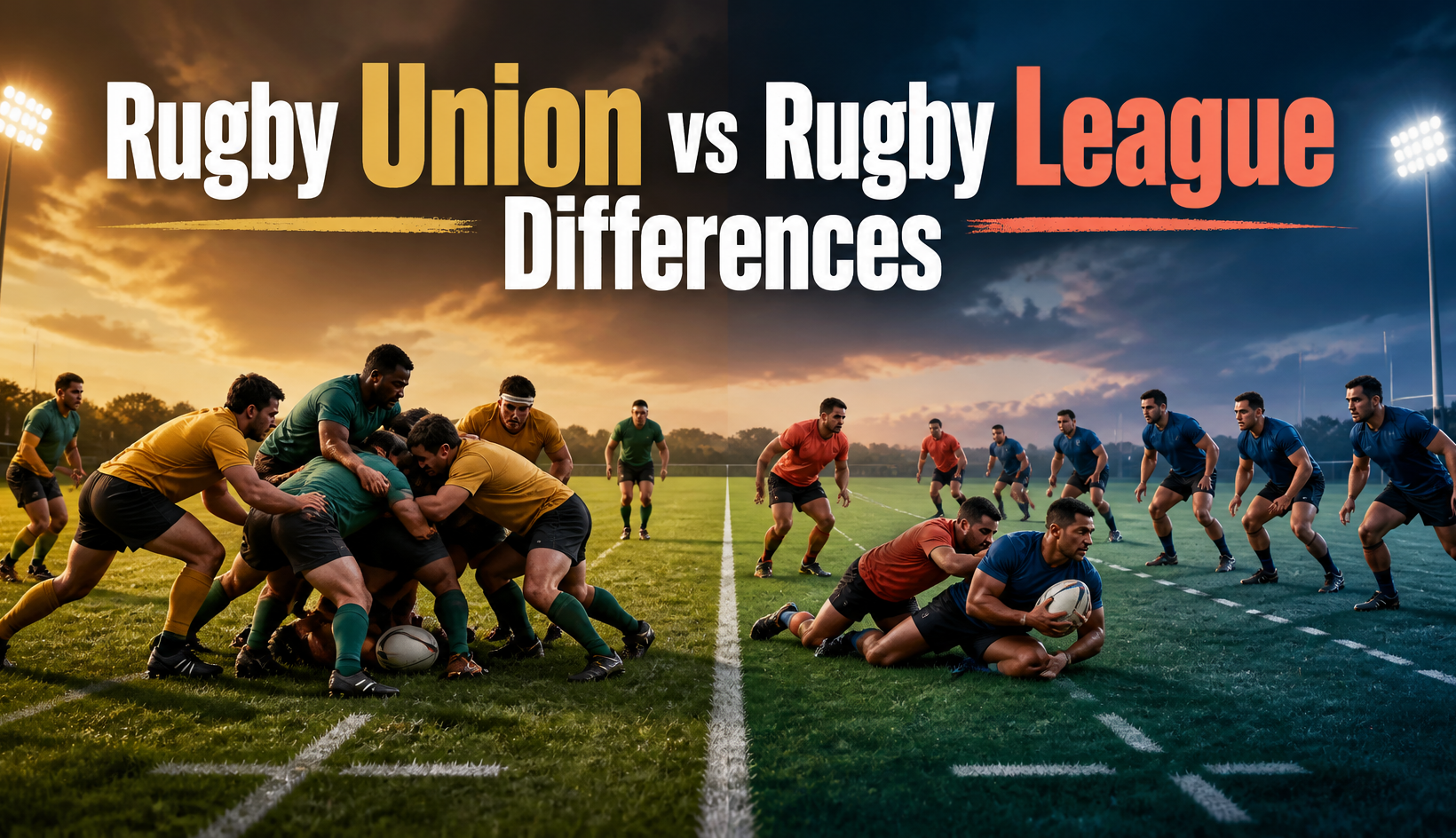
To a newcomer, rugby union and rugby league can look almost identical. Both use an oval ball, H-shaped posts, and big tackles, and both reward teams for grounding the ball over the try line. But the two codes have different rules, histories, and styles of play, and fans of each will happily tell you they are very different sports.
This guide explains the key differences between rugby union and rugby league, including team size, scoring, the tackle, set pieces, competitions, and history, so you can understand both codes with confidence.
Quick Comparison
| Feature | Rugby Union | Rugby League |
|---|---|---|
| Players on field | 15 | 13 |
| Try | 5 points | 4 points |
| Conversion | 2 points | 2 points |
| Penalty goal | 3 points | 2 points |
| Drop goal or field goal | 3 points | 1 point (2 from long range in some competitions) |
| After a tackle | Contest for the ball at the ruck | Play-the-ball, with possession kept |
| Possession limit | None | Six tackles |
| Lineouts | Yes | No |
| Scrums | Fully contested | Largely uncontested |
How the Two Codes Split
Both games come from the same roots in English football. The split happened in 1895, when clubs in the north of England broke away from the Rugby Football Union. The main issue was “broken time” payments, compensation for working-class players who lost wages by taking time off to play. The governing body insisted on strict amateurism, so the northern clubs formed their own organisation, which became rugby league.
Over the following decades, league changed its rules to make the game faster and more entertaining for paying crowds, including reducing team size and introducing the play-the-ball. Rugby union stayed officially amateur until 1995, when it turned professional.
Team Size and Positions
Rugby union has 15 players per side, split into eight forwards and seven backs. Rugby league has 13 players, with six forwards and seven backs.
The extra two forwards in union reflect the importance of contested scrums, lineouts, and breakdowns. In league, with fewer contests for the ball, forwards spend more time running hard into defences and making tackles.
Scoring Differences
The biggest scoring difference is the value of a try: 5 points in union and 4 in league. Penalty goals are also worth more in union, at 3 points compared with 2 in league.
Drop goals show another contrast. In union, a drop goal is worth 3 points and is often used to win tight matches. In league, a field goal is usually worth just 1 point, although some competitions award 2 points for longer-range attempts. As a result, kicking for goal is a bigger part of union strategy.
The Tackle: The Biggest Difference
Rugby Union: The Ruck
In union, when a player is tackled, they must release the ball, and both teams can compete for it at a ruck. Possession can change hands many times during a match, and the breakdown is one of the most important battlegrounds in the game.
Rugby League: The Play-the-Ball and Six Tackles
In league, the tackled player gets up and rolls the ball back with their foot in a play-the-ball, and their team keeps possession. Each team has six tackles to score or gain ground. After the sixth tackle, possession passes to the other side, so teams usually kick on the last tackle to gain territory.
This creates a very different rhythm. League is often described as a series of structured sets, while union has longer phases of play with constant contests for the ball.
Set Pieces
Scrums
Union scrums are a genuine contest of strength and technique, with eight forwards from each side pushing for possession. In league, scrums involve fewer players and are largely uncontested, serving mainly as a way to restart play.
Lineouts
Union uses lineouts when the ball goes out of play, with players lifted to catch the throw. League has no lineouts; play usually restarts with a scrum or a tap.
Kicking
Kicking is important in both codes, but it is used differently. In union, teams can kick at any time, and kicking for touch after a penalty gives a lineout throw, often in an attacking position. In league, the main tactical kick usually comes on the last tackle of a set, aiming for territory or a try-scoring chance.
Replacements and Officials
The codes also handle benches differently. Top-level rugby union matches usually allow eight replacements, and once a player is replaced they normally cannot return, except in certain situations such as blood or head injury assessments. Rugby league teams have a smaller bench but use a set number of interchanges, allowing players to come off and return during the match.
Both codes use video technology at the top level. Rugby union relies on the Television Match Official to review tries and foul play, while major rugby league competitions use a video review system to check tries and key decisions. In union, only the captain normally talks to the referee, a tradition that reflects the game’s strong culture of respect for officials.
Style of Play
- Rugby union: more varied, with complex set pieces, contested breakdowns, and tactical kicking
- Rugby league: faster and more direct, with repeated sets of tackles and constant collisions
Fans of union often enjoy the tactical battles and contests for possession, while league fans love the speed, physicality, and simplicity.
Major Competitions
| Rugby Union | Rugby League |
|---|---|
| Rugby World Cup | Rugby League World Cup |
| Six Nations | National Rugby League (NRL) |
| Rugby Championship and Bledisloe Cup | State of Origin |
| Super Rugby Pacific | Super League |
| Nations Championship | Pacific Championships |
Where Each Code Is Popular
Rugby union is played widely around the world, with strong followings in New Zealand, South Africa, the British Isles, France, Argentina, Japan, and the Pacific Islands, as well as Australia.
Rugby league is concentrated in fewer countries, with its strongest support in New South Wales and Queensland in Australia, the north of England, New Zealand, and the Pacific nations of Papua New Guinea, Tonga, Samoa, and Fiji.
In Melbourne, rugby league has the NRL’s Melbourne Storm, while rugby union fans follow the Wallabies, Super Rugby, and local clubs in the Dewar Shield.
Players Who Switched Codes
Many players have moved between the codes, especially in Australia. A notable example is current Wallabies coach Les Kiss, who played rugby league for the North Sydney Bears and the Kangaroos before becoming a leading rugby union coach.
Which Should You Watch?
- Choose union if you enjoy strategy, set-piece battles, and global tournaments
- Choose league if you prefer fast, simple, high-impact action
- Or follow both, since many fans enjoy each code for different reasons
Final Thoughts
Rugby union vs rugby league differences start with team size and scoring, but the biggest change is what happens after a tackle: a contest for the ball in union, and a play-the-ball with six tackles in league. Both codes share a common history from their 1895 split and offer thrilling, physical sport. With a Rugby World Cup coming to Australia in 2027, it is a great time to learn the union game.

Jante Smith is a creative and dedicated content writer who loves turning ideas into clear and engaging stories. She writes blog posts and articles that connect with readers. She ensures every piece of content is well-structured and easy to understand. Her writing helps our brand share useful information and build strong relationships with our audience.